
Compagno di Studio
An AI tutor that follows university study, one subject at a time.
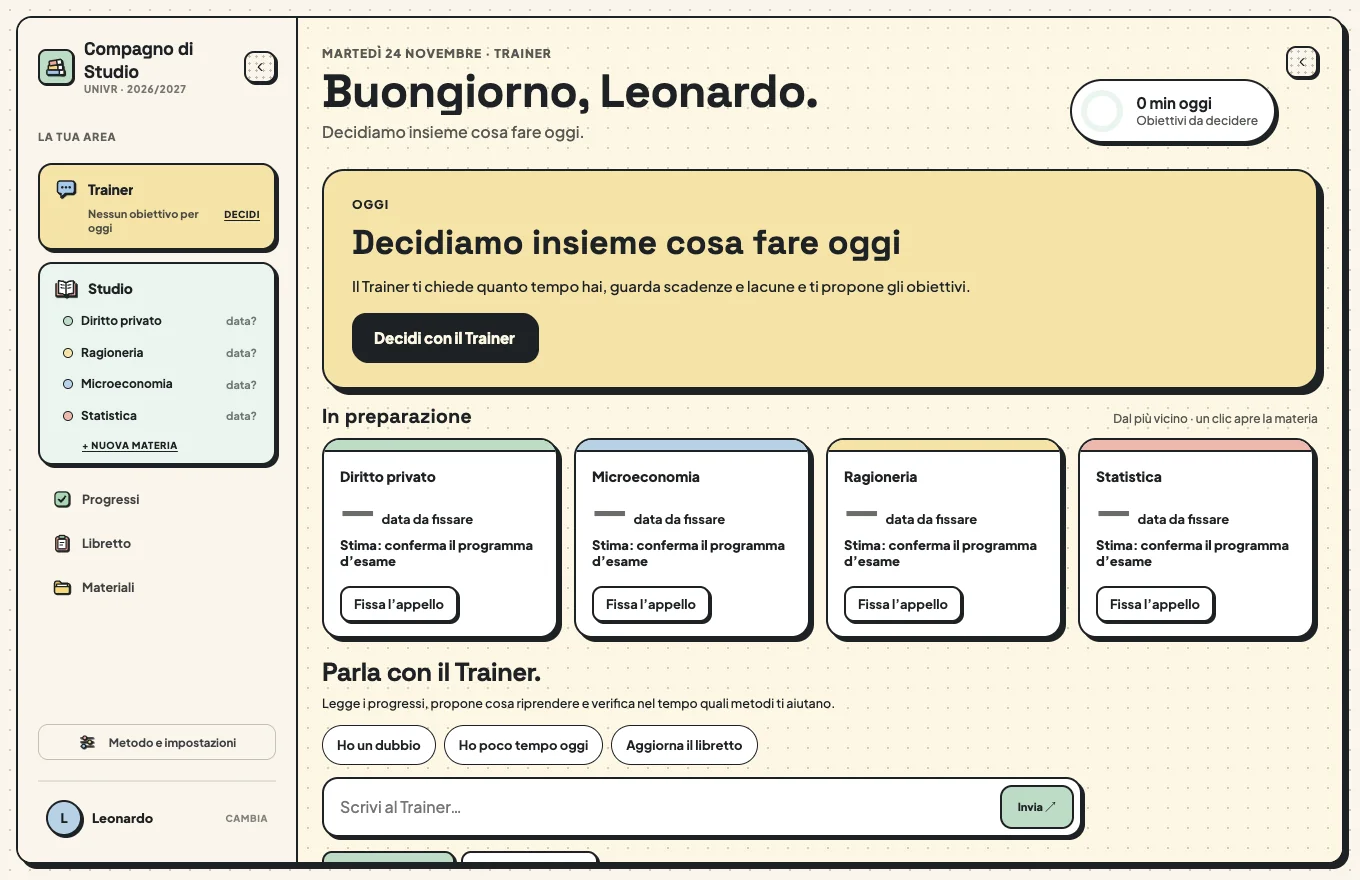
A web and desktop application in which two AI agents, a Teacher and a Trainer, support university study: block-by-block lessons on course materials, spaced checks and a plan towards each exam.
The problem
Studying with a general-purpose chatbot scatters the work. Conversations do not remember what has already been understood, do not start from the official course materials and cannot tell a topic that was explained from one still remembered days later. There is also no overall view of priorities and deadlines across subjects.
The work
I built the application around a study method rather than a chat window. The Teacher reads the subject’s materials and prepares a programme of blocks. Each block has its own conversations and closes only when the student confirms a clear, self-contained rewrite. The Trainer reads the saved progress, suggests daily goals, priorities and reviews, and grounds each suggestion in what has been recorded.
Block-by-block study from the sources
The programme comes from the course materials: PDF, Word, PowerPoint, Excel and notes. With a PDF, the “Original source” view shows the referenced page next to the explanation. Maps, flows, timelines, tables, charts and quizzes arrive in a controlled format and are displayed without running model-generated scripts; formulas are rendered with KaTeX. Confirmed blocks can be exported to Word, Markdown or PDF.
Checks and spaced review
Checks distinguish open-notes exercises, closed-notes attempts and recall days later. Questions, expected answers and marking criteria stay on the server until grading. Weak points come back in the review calendar.
From the computer to a server
It began as a local Windows app; since November 2026 it runs on a server with protected sign-in, hashed passwords and a separate archive for each person. An Electron desktop app shows the server and copies linked study folders from the computer to it.
The result
A tool in use for university exam preparation, with a transcript, a graduation-grade estimate and a grade trend. Python, JavaScript and browser tests run on simulated data and AI responses. The image on this page also shows a test profile, without real study records.
Role and tools
Concept, teaching method, architecture and end-to-end development: Flask backend, SQLite persistence, AI model integration, web interface, desktop app and tests.
Python, Flask, SQLite, OpenRouter, OpenCode, JavaScript, KaTeX, Electron